The Future of Online Education Parts I & II

By Rich Russell
PART I: The Machine Never Stops
My mom said to me recently, “In twenty-five years, none of this [waving arms about to indicate college building] will exist.” We were sitting in her office at the place where she has taught for twenty-five years now; where I have taught, as an adjunct, for four. She paused to look out the window at a lone student smoking, another relic of a former time. “In twenty-five years, all of this will be online. Administrators will realize (if they haven’t already) that it’s much cheaper to have everything online rather than to have to pay to heat and maintain buildings; much easier than having to provide classroom space. I’m sure some private universities will still exist (in the future): the Harvards and the Yales, for research and for the children of the super-rich. But for the rest of us…” — gesturing then towards her computer. “I’m glad I won’t still be teaching in twenty-five years to see that…” And then my mom smiled at me and asked, “Wanna go to lunch?”
When I later told an administrator at another school of my mom’s bleak prognostication — in a tone of I mean, it’s crazy, right? — he just sighed, “Your mom may be right” — as if plans were already in the works, the banners being delivered this afternoon, proclaiming, “Ok, Computers!” Or maybe these acclamations already festoon the hallways of our campuses.
In his short story “The Machine Stops” (1909), E.M. Forster writes of a world in which all human interaction is mediated through the Machine: everyone lives life in a solitary cell, from which one interacts with the rest of the world, with people contained to parallel rooms where all of their needs are similarly met. As Forster notes, this new civilization was in the business of bringing things to people rather than people to things: it was much more efficient this way. Rather than go the mall, order something online and have it delivered. Rather than hang out with friends, chat with them on Facebook. Rather than drive to class, log on to your course from home in your pajamas. It sounds convenient and, for the most part, inexpensive.
The inciting moment of Forster’s story is when Kuno asks his mother to come visit him, in person. “I want to see you not through the Machine,” says Kuno. “I want to speak to you not through the wearisome Machine.”
His mother responds: “You mustn’t say anything against the Machine.” And so, for the most part, we haven’t.
Now, as we enter these dyspeptic winter months, and I remind my traditional students to sign up for “text alerts” in order to be immediately notified of school cancellations, my online students know that the machine never stops: online classes prevail no matter what the weather. As the snow begins to fall and I look up from my computer at home, I shake my fist and scorn, “Do your worst, Mother Nature! You shall not deter us from our stated [online] course!” This, too, makes my life more convenient/efficient if a bit less exciting; after all, as a teacher I still long for at least one or two snow days myself. But just as the snow begins to fall, the green “snowflake” notification lights up in Blackboard indicating new mail. “Back to work,” the Machine demands. So I close the window blinds, shutting out the distracting scene…
(In Forster’s future, people grow intolerant of looking outside. Everything important is contained on a screen, they believe. They come to believe in the Machine above anything else…)
When I returned to a real-life classroom last week for my first face-to-face class this semester, my mom’s words still echoing in my ears (the ones about all colleges will be online), I imagined all of the desks and chairs replaced by aisles and aisles of cold, clean, uniform computer servers, blinking and clicking away in the darkness. Perhaps this seems an inevitable if somewhat unenviable future for us… (Lunch, anyone?)
PART II: Life Inside the Machine
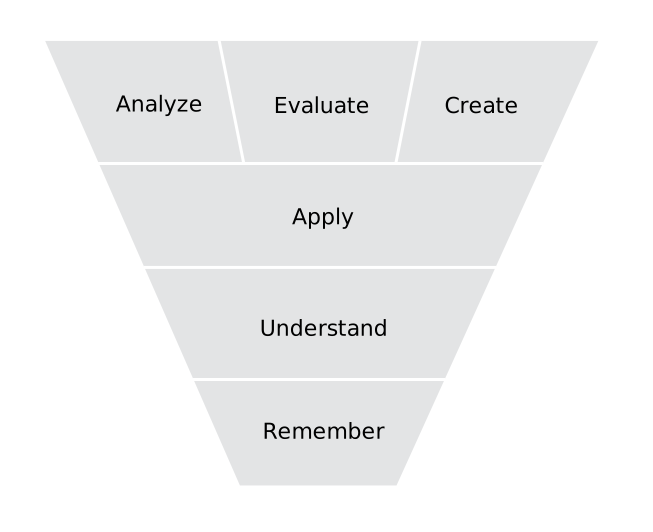
“Inside the Machine,” in Forster’s short story, Kuno’s mother Vashti is a lecturer on music history. Here, where every individual is confined to a separate room — where all needs are met by the Machine — Forster writes, “The clumsy system of public gatherings had been long since abandoned; neither Vashti nor her audience stirred from their rooms. Seated in her arm-chair she spoke, while they in their arm chairs heard her, fairly well, and saw her, fairly well.” Although each individual is “connecting” to Vashti’s lecture individually, this is done in a synchronous order: everyone logging on at the same time to hear her. Forster makes no mention of discussions occurring between lecturer and student (let alone student to student). Like a TED talk, students log on, they listen, they absorb, and then they are dispersed. Like an online model of free (or alternative) schooling, students move from lecture to lecture, learning what they like and avoiding anything that might not interest them: remembering, understanding, but often little else. The disadvantage, then, is that these objectives fall very low on Bloom’s revered taxonomy that we as teachers have been encouraged to follow. (And just to be clear, I quite enjoy a good TED talk myself from time to time.)
Even though most online education is not synchronous these days, I feel that discussion is essential to every online class, regardless of discipline: not only so that I know students are achieving those higher level thinking skills, but also so that I see them forming connections with each other. That social component — feeling like you are part of something larger than yourself, an online community of learners — I have found to be essential for the retention of students; for myself included. (For I have been a student in online classes where there was no interaction whatsoever with other students, and I have lost interest and stopped logging in.)
But it is not convenient, maybe, this creation of an online community. In order to have a class of twenty or so students, all participating in a shared experience, a common goal, you have to maintain the semester system: specified start times in the year when everyone will commence learning. As we see with for-profit colleges, why only have two semesters and a few summer sessions when you can start online, open-entry courses every few weeks — or even every day? This approach augurs the “death of the semester” as reported in The Chronicle this past October: “self-paced” courses where students submit work to the professor but are never required to discuss the information with a student cohort, because that cohort does not exist. For these courses, if students are assessed solely by self-grading, objective quizzes and tests that can be scheduled by the Machine to open and close based on the student’s progress, the teacher merely exists as an IT assistant; and we have IT assistants to be IT assistants; thus, in such classes, the professor would become entirely redundant. This is distance education as a T.V. Guide correspondence course. This is the “fast foodization of higher education” that Dr. Nicholas Burbules (Prof. Of Education, University of Illinois) refers to in the Frontline documentary College, Inc. (May 4, 2010; if you haven’t seen this program, take an hour to watch it; it’s available, of course, online).
Vashti one day receives a message from her son: “The Machine stops,” he says. In the case of the for-profit (largely online) colleges profiled in the Frontline piece, it looks like greater federal regulation might be coming. At the same time, the president calls for more students to graduate from college — and, as the program notes — community colleges (the better alternative to the for-profits) are stretched to their limits. The community college where I teach has not had to shut its doors and turn away students — yet. But if it does, where will the students who can’t be taken in go?
They will go to the Machine. They will have no choice.